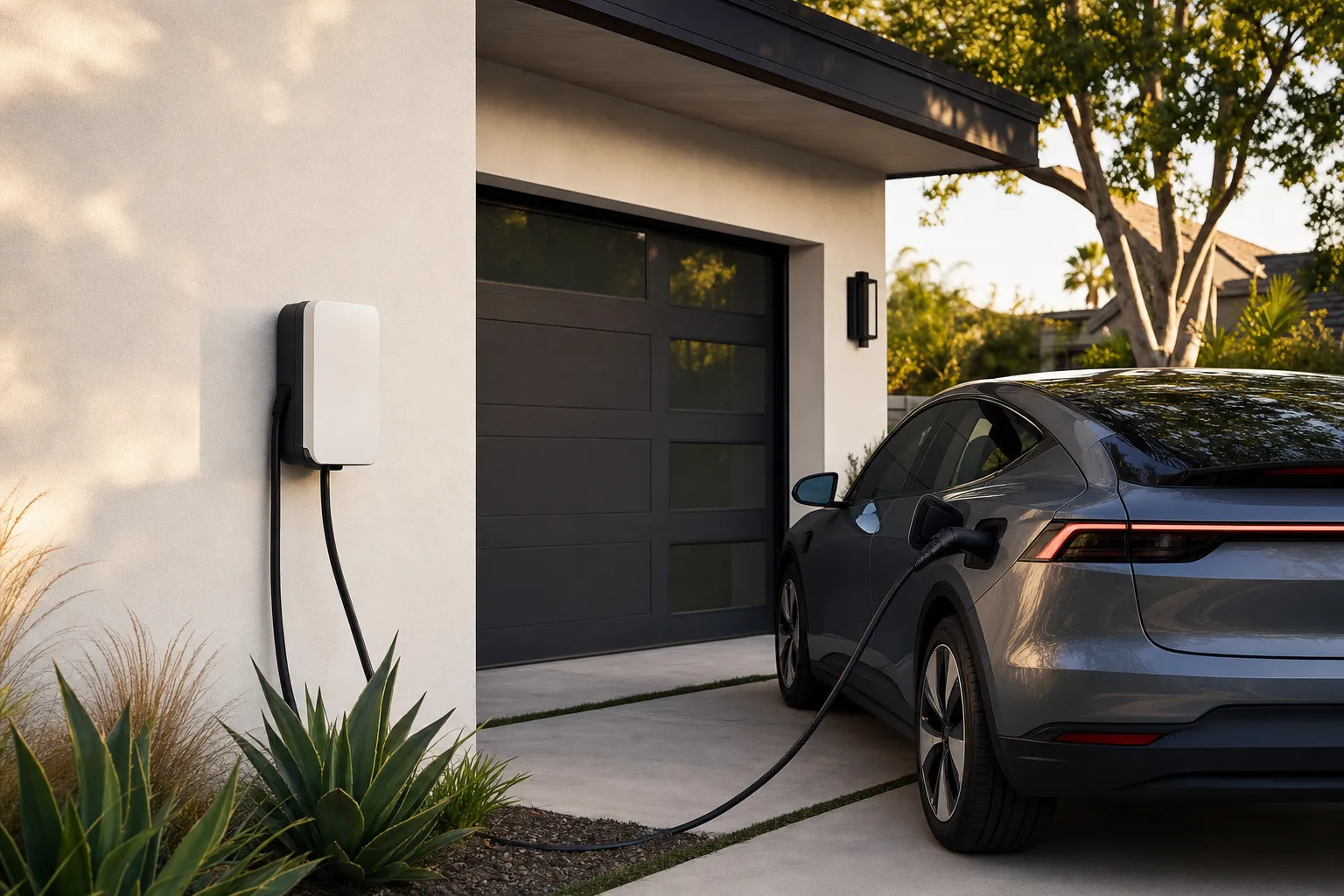
Level 2 EV charger installation in California 2026
- Green Conception Team

- May 5
- 10 min read

Key takeaways
|
California has more EVs on the road than any other state. Homeowners keep asking us about adding Level 2 charging at home, and the answers keep shifting as new chargers launch, panel upgrade rules evolve, and rebates come and go. We install EV charging alongside solar and battery projects across LA County, so we see the real-world costs, real-world permitting headaches, and real-world code requirements in 2026. Here's the honest version of what Level 2 EV charger installation costs, what brand to pick, when you need a panel upgrade, and how to maximize the rebates that still exist.
Why Level 2 is the right target for home charging
Level 1 charging (standard 120-volt outlet) adds about 3-5 miles of range per hour. That's fine if you drive 25 miles a day and plug in for 10 hours overnight. For most California EV owners, it's not enough, especially for families with multiple drivers or long commutes. Level 2 charging runs on 240-volt service (same as your dryer or oven) and delivers 25-40 miles of range per hour, depending on amperage. Level 3 (DC fast charging) is what you see at public stations, not something you install at home. The decision for 99% of California homeowners is: which Level 2 charger, and what's the install going to cost?
What Level 2 EV charger installation actually cost in 2026
The total cost breaks into three parts: hardware, installation labor, and (sometimes) electrical panel upgrade. Here's how each part runs.
Hardware: $395 to $750
Level 2 chargers range from basic 40-amp units to premium 48-amp smart chargers. Most California households want a 40-48 amp unit, which delivers roughly 30-44 miles of range per hour for most EVs. The Tesla Universal Wall Connector is our default recommendation because it handles both Tesla's NACS connector and J1772 for non-Tesla EVs without needing an adapter.
Installation labor: $500 to $1,500
Labor is where quotes vary most. A clean run from a panel in the garage to a charger on the same wall is a 2-3 hour job. Running conduit through an attic, across a long garage, or from a detached garage takes a full day or more. Ask your installer to quote conduit length, routing, and whether drywall cutting is involved. Fixed-bid is safer than hourly for EV installs; the scope usually turns out to be what it looked like on day one.
Panel upgrade: $2,500 to $5,000 if needed
This is the big variable. A 48-amp Level 2 charger needs a 60-amp breaker. Older California homes with 100-amp service panels usually don't have room for that breaker without a load calculation waiver or panel upgrade. Newer homes (post-2000) typically have 200-amp service that handles an EV charger easily. Panel upgrades run $2,500-$5,000, depending on utility coordination, permit, and any underground work. If your panel is old Zinsco, Federal Pacific, or has knob-and-tube branches, plan to upgrade regardless. See the cost table below for full scenario pricing.
Scenario | Typical cost | What's involved |
Simple: panel within 20 ft, open circuit | $1,200-$1,800 | Hardware + 2-4 hr labor + permit |
Moderate: 30-50 ft run, minor routing | $1,800-$2,800 | Added conduit, possibly attic routing |
Complex: long run through finished space | $2,800-$4,000 | Drywall cuts/patches, 1-2 day install |
Panel upgrade required (200A service) | +$2,500-$5,000 | New main panel, utility coordination |
Detached garage or outdoor pedestal | +$800-$2,000 | Trenching, weatherproof housing |
The top Level 2 chargers for 2026 California homes
These are the brands we install or recommend in 2026. Pricing is MSRP-range hardware only.
Brand / Model | Hardware $ | Max amps | App / smart | Best for |
Tesla Universal Wall Connector | $475-$585 | 48 A | Yes (Tesla app) | Tesla + non-Tesla in the household |
Tesla Wall Connector (Gen 3) | $395-$425 | 48 A | Yes (Tesla app) | Tesla-only households |
ChargePoint Home Flex | $500-$650 | 50 A | Yes (ChargePoint app) | Users wanting detailed monitoring |
Wallbox Pulsar Plus | $550-$700 | 40 A | Yes (Wallbox app) | Compact install, sleek design |
Emporia Smart Level 2 | $480-$580 | 48 A | Yes (Emporia app) | Budget + smart integration |
Grizzl-E Classic | $500-$600 | 40 A | No | Rugged indoor/outdoor, no WiFi needed |
Enphase IQ EV Charger | $650-$750 | 48 A | Yes (Enphase app) | Homes with Enphase solar ecosystem |
Our default pick: Tesla Universal Wall Connector
The Universal Wall Connector ships with the Tesla-style NACS plug but includes a built-in J1772 adapter that handles every non-Tesla EV sold in the US. For California households with a Tesla plus another EV (common with Rivian, Hyundai, Ford, GM households), this is the no-brainer pick. Tesla app integration, WiFi, 48-amp rating, and clean wall-mount design all work. The $475-$585 hardware price is competitive with non-Tesla alternatives.
When ChargePoint Home Flex wins
ChargePoint has the most mature app and monitoring ecosystem of any residential charger. If you want detailed kWh tracking, session reports, and integration with home energy management platforms, Home Flex is the better pick. 50-amp rating. Works with any EV via J1772. Slightly more expensive than Tesla at $500-$650 hardware, but the software experience is noticeably better for data-oriented users.
When the Enphase IQ EV Charger wins
If you already have an Enphase microinverter solar installation, the Enphase IQ EV Charger integrates with your Enlighten app, shows charging alongside solar production, and participates in smart energy management across the whole Enphase ecosystem. For homeowners who value the single-app experience, this is worth the $50-100 premium over Tesla.
Permits, inspections, and California code
Every city in California requires a permit for a Level 2 EV charger installation. This isn't negotiable. A licensed electrician handles the permit application on your behalf, coordinates with the city inspector, and ensures compliance with National Electrical Code Article 625, which governs EV charging equipment. Skipping the permit voids your homeowner's insurance coverage for any electrical fire and makes a future home sale harder.
NEC Article 625 requirements
Key code points your installer must follow: dedicated circuit for the charger (no shared branch), 125% load calculation at continuous rating (a 40-amp charger requires a 50-amp breaker because it's rated for continuous load), GFCI protection on plug-in installations, appropriate wire gauge (typically 6 AWG copper for 40-48 amp chargers), and proper grounding. If any of these aren't in the permit package, push back on the installer.
CALGreen and building code for new construction
Under California's CALGreen code, new single-family homes must include EV-ready wiring (a dedicated circuit conduit run to the garage or parking area). Homes built after 2020 typically have this pre-wiring already installed, which cuts installation labor significantly. If you're in a home built since 2020 and haven't used the EV-ready circuit yet, look in your electrical panel for a labeled breaker or blank slot with dedicated wiring to your garage.
Permit timeline in California cities
Permit pull and inspection typically add 1-3 weeks to the install. LADWP permits come through fast (3-7 days in our experience). SCE-territory cities vary: Pasadena is fast, Glendale is moderate, and Santa Clarita can be slower. Budget 2-3 weeks from contract to energized charger for most projects.
Rebates and tax credits for EV chargers in 2026
The EV charger tax credit and rebate landscape is actually better than the solar tax credit landscape in 2026. Here's what's still active.
Federal 30C Alternative Fuel Refueling Property Credit
The federal 30C credit covers 30% of hardware plus installation costs, up to $1,000 per charger. It's active through mid-2026 under current law. Eligibility is limited to addresses in low-income or non-urban census tracts. The IRS maintains a lookup tool to check whether your address qualifies. For California, most rural and inland-empire addresses qualify; dense LA proper often doesn't. Claim via IRS Form 8911 when filing your tax return.
California utility rebates
SCE, PG&E, SDG&E, LADWP, and SMUD each run different EV charging rebate programs. As of April 2026, SCE offers up to $1,000 through the Charge Ready Home program. PG&E's EV Charge Network rebate is available for qualifying addresses. LADWP's EV Charging Station Rebate offers $500 for qualifying Level 2 installs. SMUD has some of the best rebates in California at up to $1,500 through its Residential EV Charger Program. Rebate programs change frequently; confirm current amounts with your specific utility when you quote.
TOU rate enrollment
Many California utilities offer reduced off-peak EV rates when you enroll in EV-specific time-of-use plans. SCE's TOU-D-PRIME and PG&E's EV2-A plans can cut your effective overnight charging rate to 18-25 cents per kWh instead of the standard 35-45 cents. Enrolling is free and happens through your utility account after the charger is installed. The savings on a typical 10,000-mile-per-year EV are $300-$600 per year.
Pairing EV charging with solar and battery
This is where the math gets really good for California homeowners with high EV consumption.
Solar sizing for an EV
A typical EV driven 10,000-12,000 miles per year adds 3,000-4,000 kWh to your annual electricity consumption. That's like adding another 3-4 kW of solar capacity to your roof. If you don't size up your solar when adding an EV, you'll go from offsetting 90% of your usage to offsetting 55-65%. When we quote solar for EV households, we add 3-4 kW to the baseline system size. Bigger system, more panels, slightly higher cost, but the math keeps working.
Why a battery matters more if you have an EV
Under NEM 3.0 explained, midday solar exports credit at 5-8 cents while evening grid power costs 35-45 cents. An EV charging overnight from the grid at 35 cents is much more expensive than charging from a stored solar battery at an effective 5-cent cost. A Tesla Powerwall 3 paired with solar and an EV captures midday production, stores it, and dispatches it overnight to the EV. That arbitrage is worth $400-$800 per year on a typical EV household.
Common installation mistakes (and how to avoid them)
We've been called to fix these enough times to name them:
Under-sizing the circuit. A 32-amp circuit for a 40-amp charger works until it trips and you start wondering why your car isn't fully charged in the morning. Size the circuit for 125% of the charger's rated amperage per NEC 625.
Skipping the permit. It's not worth it. The permit costs $100-$400, depending on jurisdiction, and skipping it creates insurance and resale problems later.
Installing an outdoor charger without proper weatherproofing. Tesla and ChargePoint units are rated for outdoor use, but the conduit, junction box, and wire terminations must also be NEMA 3R or better.
Not checking the panel capacity before buying the charger. If your panel is full, you'll need a load calculation waiver, a sub-panel, or a full upgrade. Check first.
Choosing a non-NACS charger if you drive a Tesla and may upgrade. NACS became the US standard in 2024. Non-NACS chargers will be adapter-dependent for new Teslas. The Universal Wall Connector future-proofs this.
Frequently asked questions
How long does EV charger installation take?
For a simple install (panel within 20 feet of the charger location, adequate panel capacity, no routing through finished space): 2-4 hours on site. Add 1-3 weeks for permit pull and inspection. Complex installs with panel upgrades can extend to 1-2 days of on-site work plus 2-4 weeks of utility coordination for the panel upgrade.
Do I need a 200-amp service panel for Level 2 charging?
Not always. Many 100-amp panels handle a Level 2 charger with a load calculation showing total connected load is within capacity. Your electrician runs this calculation as part of the quote. If you have central AC, an electric oven, an electric dryer, and plan to add a heat pump, 100-amp probably isn't enough long-term. If you're already planning other electrification, upgrade the panel once and be done.
Is it safe to charge my EV on a regular 120-volt outlet?
Yes, that's Level 1 charging. It works but delivers only 3-5 miles of range per hour. Fine for emergencies or very low-mileage drivers. Not practical for most California EV owners.
Will a Level 2 charger drain my home's electricity capacity?
No. A Level 2 charger draws 40-48 amps when charging, which is significant but within the design capacity of most modern California homes. Your electrician's load calculation confirms this before installation. If you have solar, much of the EV charging can come from solar production instead of the grid, which reduces the peak demand issue further.
Can I install an EV charger myself?
In most California jurisdictions, no. Level 2 EV charger installation requires a permit, which requires a licensed electrician's sign-off. DIY install voids insurance and violates NEC 625. A plug-in (NEMA 14-50 outlet) for a Level 2 cord set is technically simpler but still requires a permit and licensed electrical work. Not worth the risk.
Which EV charger works with both Tesla and non-Tesla cars?
Tesla Universal Wall Connector (with built-in J1772 adapter), ChargePoint Home Flex (uses J1772, with Tesla adapters available), Wallbox Pulsar Plus (J1772), Emporia Smart Level 2 (J1772). Tesla drivers need the NACS-to-J1772 adapter or vice versa, depending on the charger. The Universal Wall Connector is the cleanest "just works" option for mixed-EV households.
Should I wait to install an EV charger?
No. The 30C federal credit is available through mid-2026 but could expire with future legislation. Utility rebates are active now but subject to funding. Installation costs aren't going down meaningfully. If you have an EV or are buying one in the next 6 months, install now.
The bottom line on EV charger installation in California
Level 2 EV charger installation in California runs $1,500-$3,500 for most homes in 2026. Tesla Universal Wall Connector is the default pick for most households. Federal 30C tax credit and state/utility rebates can cut $500-$2,200 off the total out-of-pocket. If you have solar or are planning to install the charger and the solar together to maximize the long-term savings. We install dynamic Level 2 EV chargers across LA County with our roofing and solar crews coordinated as one team. If you want us to walk your panel, assess your load capacity, and quote the charger install for your specific house, the visit is free.
Ready to add Level 2 EV charging to your California home? We'll check your panel capacity, recommend the right charger, handle the permit, and pair it with your solar if you have one. CSLB-licensed. Free quote. |