


NEM 3.0 Explained: What California Solar Owners Actually Need to Know
- Green Conception Team

- 11 hours ago
- 6 min read
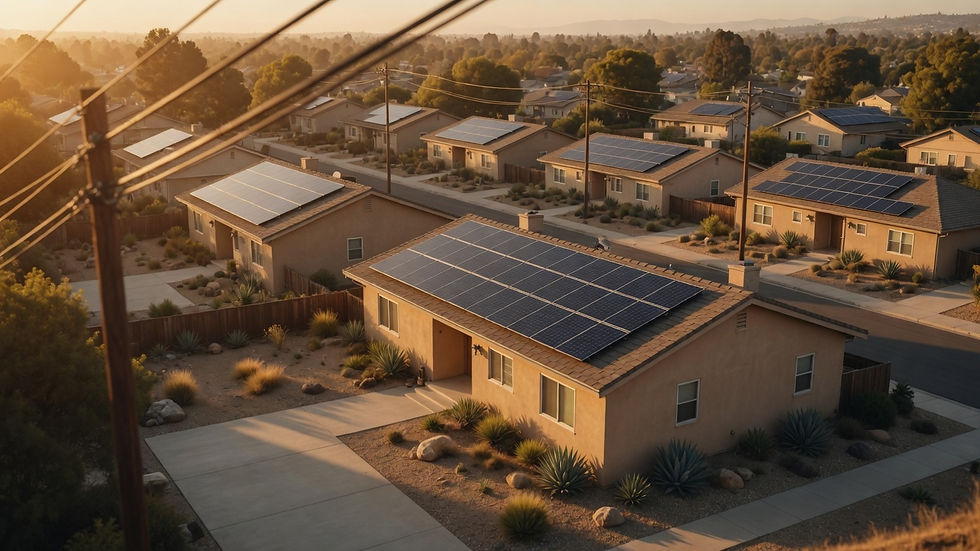
If you have heard that solar "isn't worth it anymore in California," you have heard someone talking about NEM 3.0 without finishing the sentence. The truth is more specific, and it matters which utility you are on. For some California homeowners, NEM 3.0 genuinely changed the math. For others, it changed nothing at all.
We are Green Conception, a licensed California solar installer (CSLB #964965). We design systems for customers on every major utility in the greater Los Angeles area. Here is what NEM 3.0 actually is, who it hits, who it doesn't, and what it means for your decision in 2026.
What NEM 3.0 Actually Is
NEM 3.0 is the common name for California's Net Billing Tariff, approved by the California Public Utilities Commission and in effect for new solar customers since April 2023. It replaced the older NEM 2.0 program for the state's three big investor-owned utilities.
The core change is in how you get paid for the solar power you send to the grid. Under the old rules, a kilowatt-hour you exported was credited at close to the retail rate, roughly what you would pay to buy one back. Under NEM 3.0, exports are credited at "avoided cost" rates instead, which are tied to what it would cost the utility to source that power on the wholesale market. Those rates are a fraction of retail, and they change by the hour and the season.
In practice, that means a kilowatt-hour you export to the grid in the middle of a sunny afternoon is now worth far less than it used to be, while the power you pull from the grid in the evening still costs full retail price. The gap between those two numbers is the whole story of NEM 3.0.
Who NEM 3.0 Affects, and Who It Doesn't
This is the part most articles skip, and it is the single most important thing to understand.
NEM 3.0 applies to the three investor-owned utilities:
- Southern California Edison (SCE)
- Pacific Gas and Electric (PG&E)
- San Diego Gas and Electric (SDG&E)
NEM 3.0 does NOT apply to publicly owned utilities, which set their own net metering policies. In our service area, that includes:
- Glendale Water and Power (GWP)
- Los Angeles Department of Water and Power (LADWP)
- Burbank Water and Power (BWP)
- Pasadena Water and Power (PWP)
If you are a GWP customer in Glendale, NEM 3.0 does not touch you. GWP still runs a 1:1 net metering arrangement, where the power you export is credited at the same rate you pay to buy it back. That is the favorable, old-style arrangement that the IOUs moved away from. The same is broadly true for LADWP customers.
So before you absorb a single worry about NEM 3.0, find out which utility serves your address. For a large share of our customers, the answer makes the entire concern irrelevant.
What NEM 3.0 Means If You Are on SCE, PG&E, or SDG&E
If you are on one of the three big IOUs, NEM 3.0 is real and it changes how a solar system should be designed. It does not make solar a bad investment. It makes solar designed for the old rules a bad investment.
Under NEM 2.0, the smart move was to size a system to cover 100 percent of your annual usage and let the grid act like a free battery, banking your daytime surplus at retail value and letting you draw it back at night. That strategy no longer works, because the surplus you export is now credited at a small fraction of what you draw back costs.
Under NEM 3.0, a solar-only system that exports a lot of midday power captures only a portion of the value it used to. The exact figure depends on your rate plan and usage pattern, but a solar-only system on an IOU now captures meaningfully less of its potential value than the same system would have under the old rules. The power you use directly from your panels during the day is still worth full retail to you. The power you export is worth much less.
That single shift is why the conversation has moved from "solar" to "solar plus storage."
Why a Battery Went From Optional to Central
Under NEM 3.0, the most valuable thing you can do with a kilowatt-hour of solar is use it yourself rather than export it. A home battery is what lets you do that after the sun goes down.
Here is the logic. Your panels produce the most in the early afternoon, exactly when your home uses the least and when export credits are at their lowest. Your home uses the most in the evening, after work, when the sun is down and grid power is at its most expensive peak rate. A battery stores your cheap afternoon production and discharges it during the expensive evening peak, so you are buying far less high-priced grid power.
Under NEM 2.0, the grid did this shifting for you at no cost. Under NEM 3.0, a battery does it instead. That is why, for SCE and PG&E customers, we now model nearly every project as solar plus an Enphase IQ Battery 10C or Tesla Powerwall 3 from the start. The battery is no longer a backup-power luxury. On an IOU, it is central to the financial case.
For homeowners worried about outages on top of bill savings, the battery does double duty: it shifts your energy to dodge peak rates and it keeps your essential loads running during a grid outage. One piece of hardware, two reasons to own it.
The GWP Advantage
For Glendale homeowners on GWP, none of the above applies to your export credits. GWP's 1:1 net metering means a system sized to cover your annual usage still does exactly that. You bank surplus in spring, draw it down in summer, and close the year near zero on the variable charges.
This does not mean a battery is pointless for a GWP customer. It means the reason to buy one is resilience, not rate arbitrage. If you are in a Glendale fire-hazard zone that sees Public Safety Power Shutoffs, a battery is worth serious consideration for backup. But you are not being pushed toward one by a punitive export rate the way an SCE customer is. Your solar math is simply more favorable, full stop.
What About Existing Solar Owners? (NEM 2.0 Grandfathering)
If you already had solar interconnected under NEM 2.0 before the cutover, you are grandfathered onto those older, more favorable terms for a set period from your interconnection date. You did not get moved to NEM 3.0 automatically. This is worth confirming with your utility, but existing NEM 2.0 systems generally keep their original arrangement for years.
The catch comes if you significantly expand an existing system. Major additions can trigger a move to current rules, so if you are thinking about adding panels to a grandfathered NEM 2.0 system, get the specifics before you do, because the change can affect the whole system's status.
Frequently Asked Questions
Is solar still worth it in California under NEM 3.0?
Yes, but the design matters more than it used to. For GWP and LADWP customers, nothing changed and solar remains strongly worth it. For SCE, PG&E, and SDG&E customers, solar is still worth it when the system is designed for self-consumption and paired with a battery. A solar-only system designed as if NEM 2.0 still existed is the thing that no longer pencils out well.
What is the difference between NEM 2.0 and NEM 3.0?
NEM 2.0 credited your exported solar at close to retail rates. NEM 3.0 credits exports at avoided-cost rates that are a fraction of retail and vary by time and season. NEM 2.0 rewarded oversizing and exporting; NEM 3.0 rewards self-consumption and battery storage.
Does NEM 3.0 apply to GWP customers in Glendale?
No. GWP is a publicly owned utility and sets its own net metering policy. GWP currently offers 1:1 net metering, so NEM 3.0 does not affect Glendale GWP customers.
Do I have to get a battery under NEM 3.0?
You are not required to, but on SCE, PG&E, or SDG&E, a battery substantially improves the economics because it lets you use your own solar in the evening instead of exporting it cheaply. For most IOU customers, we recommend modeling the project with storage included.
Will my export rates under NEM 3.0 ever change?
The avoided-cost values that determine export credits are updated periodically and vary by hour and season. The structure is set, but the specific numbers move. We model your project against current values at the time of your proposal.
Bottom Line
NEM 3.0 did not kill solar in California. It ended the era of designing a system to bank cheap surplus on the grid, and it did that only for customers of the three big investor-owned utilities. If you are on GWP or LADWP, your math is unchanged and favorable. If you are on SCE, PG&E, or SDG&E, solar still works, but it works best designed for self-consumption with a battery in the picture from day one.
The right answer depends entirely on your utility, your usage, and your roof. We model all three before recommending anything. CSLB #964965.
Ready to find out what solar actually looks like under your specific utility? Share your last 12 months of bills, and we will model it against current rates, whether you are on GWP's 1:1 net metering or an SCE NEM 3.0 plan. Get a Free Solar + Battery Assessment |


